Alcohol, coffee and fizzy drinks after an extraction
One of these three is named in the published guidance. The other two are not, and this page is careful about the difference.
Read on Sep 24, 2026
Four documents · read 24 September 2026 · no dentist reviewed it
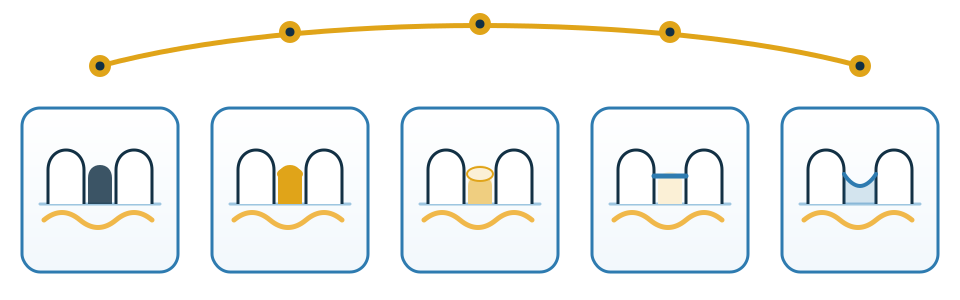
The five panels run left to right, in that order.
Socket Sense reads published documents so you do not have to: three public fee schedules for the money, and two national health bodies for the healing. Every figure on the site names the document and the day we read it. Nobody here is a dentist, and we say so on every page.
Every sentence in this strip is quoted or closely paraphrased from a page named on our facts page. The strip adds nothing of its own, which is the only reason it can exist on a site no clinician has read.
Because the two organisations that describe healing well — the NHS and the American Dental Association — publish no prices, and the organisations that publish prices describe healing not at all. So this site keeps the two apart. The healing pages quote health bodies. The cost page quotes fee schedules, line by line, and shows the arithmetic whenever a total is ours rather than theirs.
On 24 September 2026 we went looking for a free, public, primary source that publishes what an American dental surgery actually charges a cash patient to take a tooth out. We did not find one. Rather than soften that into a range with a plausible shape, we priced the thing that is published: what three public payers say they will pay a dentist per tooth. Those are not retail prices, and the cost page says so before it says anything else.
Two landing pages and ten short entries, in roughly the order the worries arrive.
No. Socket Sense is written by researchers who read published documents and check the arithmetic. No dentist reviews it, no dentist is named on it, and no page here carries a reviewer in its structured data. If you want a page a clinician has signed, this is not one.
No, and neither can any website. A socket is assessed by somebody who can see it, ideally the person who made it. What this site can do is quote what published guidance calls ordinary healing and what it calls a reason to ring — see dry socket, or ordinary healing.
Because the schedules are published, dated, complete and free to read, and surgery price lists mostly are not. A payer maximum is not what a cash patient is charged; it is a floor under an argument, and it is the only figure in this area that anybody can check. The cost page repeats that caveat in the sentence beside every number.
Two links on this site are paid, both on cost pages, both labelled in the paragraph above them. We turned down four other ways to be paid, including the obvious one — being paid when a frightened reader books an appointment — and the reasons are written out on the disclosure page.
Every document on the site was read on 24 September 2026, and each carries its own effective date: 1 January 2026 for Louisiana, 1 July 2026 for Illinois, a run date of 16 September 2026 for Arkansas, and June 2026 for the Vermont rule book. Fee schedules are reissued; a link to a newer one is the most useful message we can get.
The day book
One of these three is named in the published guidance. The other two are not, and this page is careful about the difference.
Read on Sep 24, 2026
Both published sources cover this, they agree, and the instruction is narrower than people assume — including about salt water.
Read on Sep 24, 2026
The difference, as two published sources describe it — and the honest admission that a website cannot tell them apart for you.
Read on Sep 24, 2026
Three different questions hide inside one search. Two of them have published answers, and one of them is the only number in this area that a health body puts a ceiling on.
Read on Sep 24, 2026
Three published lists between them cover this, and they agree on more than they disagree. None of them can be applied to your own face by a website.
Read on Sep 24, 2026
Coverage is three separate mechanisms wearing one word. The published schedules show all three, and the pattern in them is not the one most people expect.
Read on Sep 24, 2026
Four kinds of being kept comfortable, described by the ADA and priced by the quarter-hour on every schedule we read — with one schedule that prices none of it for adults.
Read on Sep 24, 2026
Smoking is one of the few behaviours the published guidance names directly. Vaping is not named at all, and this page is honest about what that silence is worth.
Read on Sep 24, 2026
The two most precise instructions in all of the published guidance both belong to the first day, and both are about the same thing.
Read on Sep 24, 2026
What the published sources actually describe happening in a socket over a fortnight, including the pale tissue that sends people searching in the middle of the night.
Read on Sep 24, 2026